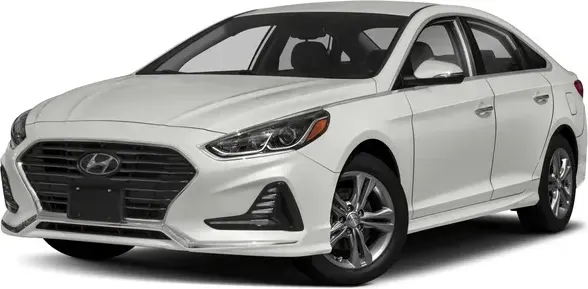
2018 Hyundai Sonata: What to check before buying
Owners have filed 353 complaints with NHTSA about this car, most about the engine, electrical, and transmission. The 9 checks below target those problems, in the order you would do them at the car.
 2018
- Owner complaints
- 353
- Recalls
- 2
- Crashes reported
- 17
- 21 injuries
Your inspection sheet
Tick items off on your phone at the car, or print it. Ticks stay on this device.
0/9 checked
2018 Hyundai Sonata: inspection sheet
Paperwork and questions
Before you go, or before you touch the car0/3
Cold start, engine bay, and underside
Ask the seller not to warm the car up first0/4
Test drive
At least 20 minutes, with some highway0/2
These checks are specific to this model year. For tires, body panels, fluids, and the other basics every used car needs, use the general inspection guide.
Which Sonata is it?
EPA figures for each version of the 2018 Hyundai Sonata. Use them to confirm you are looking at the version that was advertised, and as a yardstick on the test drive.
| Version | Drive | EPA rating |
|---|---|---|
| 1.6L 4-cylGas | FWD | 31 mpg |
| 2.0L 4-cylGas | FWD | 26 mpg |
| 2.4L 4-cylGas | FWD | 29 mpg |
| 2.0L 4-cylHybrid | FWD | 42 mpg |
| 2.0L 4-cylPlug-in hybrid | FWD | 600 mi range |
- The 2018 Hyundai Sonata was sold in five versions. Confirm which one this is from the window sticker, the engine cover, or the VIN report before you compare prices.
- On the hybrid, watch for the car moving off on electric power at low speed and for any hybrid system warning on the dash.
- Reset the trip computer at the start of the drive. A Sonata that averages well under the EPA 26 mpg combined on a mixed route may have an engine or tire problem.
Check the odometer against these mileages
Owners report these failures starting around the mileages below. A car inside one of these ranges deserves a closer look at that part, or records showing it was already fixed.
Low-speed unintended acceleration
500–20,000 miles
ABS module warning lights
19,639–40,000 miles
Early starter failure
35,683–50,000 miles
Excessive oil consumption
57,000–118,000 miles
Why these checks: what owners reported
NHTSA complaints for the 2018 Hyundai Sonata, grouped by the part owners named. Open a row to read what goes wrong.
Engine1301 crash
Heavy oil burning with no visible leak is the dominant complaint, sometimes a quart every 750 to 1,000 miles or faster. Low-oil warnings, dry dipsticks, misfires, knocking, blue smoke and fouled spark plugs follow. Some cars go into limp mode, cap speed at 40 mph or seize. Most reports fall between about 65,000 and 118,000 miles. Dealers usually order a 1,000-mile oil consumption test, and many owners report denied warranty claims, though some received a new engine. Four complaints involve fire, including cars that ignited while parked.
Low-oil warning lights and empty dipsticks are the most common report, usually with no leak found. Dealers respond with oil consumption tests and sometimes call the result normal. Reported failure mileages run from about 57,000 to 118,000. Some cars misfire, vibrate, lose power and stall at speeds up to 70 MPH, and one dealer called for an engine replacement. Separate reports describe oil leaking at the drain bolt from a cracked oil pan, which one dealer called a weld crack.
Electrical521 crash
Sudden power loss at highway speed is the main pattern. A flashing check engine light, jerking and a refusal to accelerate come with it. Several cars failed soon after a recall software update at low mileage, and dealers replaced wiring harnesses or sensors. Hybrids show a "Check hybrid system" warning and shut down, sometimes traced to the electric water pump. Other reports describe no-start conditions and failed starters, heavy oil use, and radio static. Three complaints involve fire, and one describes a crash in which neither the brakes nor automatic emergency braking slowed the car.
Transmission301 crash
Cars drop into limp mode with a flashing check engine light, shake, and will not accelerate. Some stall outright at highway speed. Several owners report limp mode shortly after the Campaign 953 software update on cars with only 5,400 to 5,560 miles, and dealers then pointed to engine or wiring harness replacement. Later reports describe knock sensor codes, rod bearing failure, a cracked piston and heavy oil use. One complaint involves fire while driving, one a crash after stalling, and one a back injury from a sudden jerk.
Exterior lights20No crashes
Low-beam headlights light only a short distance ahead, often described as 15 to 20 feet or one to two car lengths. Each beam also casts dark notches or a half-moon shadow that shifts during turns. Drivers report the problem from new and say they rely on high beams on dark roads. Dealers and the manufacturer describe the pattern as an anti-glare design and decline to replace the headlamps. A separate report describes backup bulbs burning out and damaging the bulb holder.
Acceleration and cruise control115 crashes
The car accelerates on its own at low speed while parking or reversing, and the brakes reportedly fail to stop it. Five of the 11 complaints involve crashes into poles, walls, trees or posts, several at very low mileage. Dealers often cannot reproduce the problem. Other reports describe limp mode with no response to the pedal, highway stalls with racing RPM, and automatic emergency braking that fails to stop for vehicles ahead. Some owners worry about sudden power reduction after the Campaign 953 update.
Brakes94 crashes
These reports describe failures that leave the driver unable to stop. Pedals sink to the floor or go stiff, and four complaints involve crashes, including one fire crash with 11 injuries. ABS faults also appear. A failed ABS module or HECU can disable ABS, traction control, forward collision prevention, auto hold and cruise control at once, and one repair estimate came to about $3800. Other owners report brakes that pulsate and lock up, or automatic emergency braking that engages for no reason and nearly causes rear-end collisions.
Seat belts82 crashes
Belts fail to retract, lock up and keep tightening during normal driving, or refuse to latch in the buckle. Passenger-side lockups return even after the dealer replaces the unit. Two complaints describe crashes in which the driver's belt reportedly did not hold, with injuries including bruising and a heart contusion. One buckle failure appeared at 45,000 miles, and the dealer confirmed the fault without repairing it.
Airbags42 crashes
Airbags failing to deploy in hard impacts is the main concern in this small group of four complaints. One driver ran under a semi truck and another took a hard front-right hit at about 45 miles per hour, and no bags deployed in either case. A police investigator reports a fatal crash in which the steering wheel airbag detached and struck the driver. One owner reports three airbags deploying with no impact while driving at 50 miles per hour.
In owners' own words
Excerpts from complaints Sonata owners filed with NHTSA, as written. Listen for the same symptoms on your test drive.
I bought this vehicle as a certified pre-owned from a Hyundai dealership on 09/10/2022 with 32,677 miles. Around 85,000 miles, it began burning an excessive amount of oil—about two quarts per month. Now, with approximately 101,000 miles, it still burns two quarts weekly, oil is being expelled from the muffler, and the exhaust has started to glow red. I have tried contacting Hyundai but have not received any response.
Filed with NHTSA, December 2025
The vehicle is burning oil at a high rate in a short period of time, a known issue that is affecting thousands of other people, and Hyundai refuses to issue a recall to fix this issue. If I forget to add oil every 500-1000 miles, I risk the engine locking up while driving. Their cars are dangerous to drive and are unsafe to be on the road with other drivers. They put profit over the safety of their customers.
Filed with NHTSA, October 2024
Unknown. 2018 Hyundai Sonata engine has failed. Only purchased the vehicle in December 2024, and the engine is defective. There is much information, via research, indicating that Hyundai is aware of the engine issues with this year vehicle, but are unwilling to make amends. Vehicle has 100,189 miles.
Filed with NHTSA, November 2025
On May 03, 2022 at approximately 3:30pm I was traveling southbound on Arizona State Route 101 in Tempe, Arizona. I was going about 75 mph, and without no warning my car shut off. I had to pull off to the shoulder of the highway to avoid being struck by other vehicles, and also incase I lost control. My Hyundai picked up nails on 3 of the 4 tires in the process. I barely avoided a fatal accident due to the defect, which I had no idea about.
Filed with NHTSA, August 2022
Starter replaced at less than 50,000 miles. Normally a starter will last 150,000 miles or more. I was past the warranty by 9 months but was under the mileage. Warranty was 5 years or 50,000 miles. Hyundai parts are cheap and do not last long compared to other companies.
Filed with NHTSA, January 2024
When my car suddenly stopped on the highway, I encountered an issue with the “body control module.” The car wouldn’t start, and the key fob was ineffective. Additionally, the airbags stopped working. I don’t recall all the details, but I was unsure of where to report the dangerous vehicle. I’ve noticed several other Hyundai owners complaining about this issue, where their cars suddenly stop in the middle of nowhere.
Filed with NHTSA, December 2024
Back up lights. The lights constantly burn out causing the harness light holder to burn out. The lights will not come on even after replacing fuse and lights There are not back lights to warn patrons on the road for turning or stopping Yes it was taken to a dealership No it has not been inspected my either , but there is a recall on models of the same car but years 2011-2014 No there were no warnings , someone told me they were out
Filed with NHTSA, August 2025
How the 2018 compares with other Sonata years
Complaints for this year next to the average for the other model years, area by area.
The 2018 has the most owner complaints of the 8 Sonata years we cover, about 3.5 times the average of the others. Newer years have had less time to collect complaints, so compare like with like.
- Engine13018
- Electrical5216
- Transmission3014
- Exterior lights203
- Acceleration and cruise control112
- Brakes91
Where the 2018 fits in the Sonata's history
Redesigns and mid-cycle updates change what can go wrong.
The 2018 is the fourth model year of the Sonata's seventh generation (2015–2020).
It includes the 2017 update.
What changed for 2017
- New interior and exterior design features
- Updated infotainment options
Recalls to confirm (2)
Recall repairs are free at any Hyundai dealer, but the seller may never have had them done. Check each campaign number against the VIN.
21V619000Door latches and locksAug 2021
Hyundai Motor America (Hyundai) is recalling certain 2017-2018 Sonata, 2016-2018 Sonata Hybrid, 2018-2020 Accent, and 2016-2017 Azera vehicles. The trunk latch may become damaged, preventing the opening of the trunk from the inside. As such, these vehicles fail to comply with the requirements of Federal Motor Vehicle Safety Standard number 401, "Internal Trunk Release.".
Risk: A person inside the trunk compartment may become trapped, increasing their risk of injury.
Fix: Dealers will replace the trunk latch base, free of charge. Owner notification letters were mailed December 4, 2021. Owners may contact Hyundai customer service at 1-855-371-9460. Hyundai's number for this recall is 208.
18V166000Fuel systemMar 2018
Hyundai Motor America (Hyundai) is recalling certain 2016-2018 Hyundai Sonata Plug-In Hybrid vehicles. These vehicles are equipped with a Voltage Protection Device (VPD), designed to protect the high voltage battery module, that may activate inadvertently.
Risk: If the VPD activates while the vehicle is being operated in Electric Vehicle (EV) mode, there may be a loss of power, increasing the risk of a crash.
Fix: Hyundai will notify owners, and dealers will remove the VPD switch and install a new Battery Management System (BMS) that contains an Overvoltage Protection Device (OPD). The recall is expected to begin May 2018. Owners may contact Hyundai customer service at 1-855-371-9460. Hyundai's number for this recall is 175.
Also looking at these instead of a Sonata?
Cars shoppers compare with the Hyundai Sonata, with their own 2018 checklists.
2018 owner complaints, side by side
- Subaru Legacy116
- Nissan Altima217
- Kia Optima230
- 2018 Hyundai Sonata353
- Ford Fusion429
- Toyota Camry708
- Honda Accord1,739