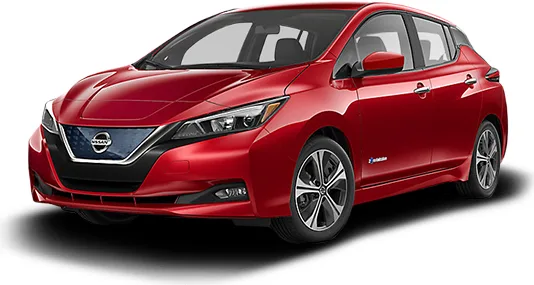
2019 Nissan Leaf: What to check before buying
Owners have filed 251 complaints with NHTSA about this car, most about the electrical, fuel system, and transmission. The 9 checks below target those problems, in the order you would do them at the car.
 2019
- Owner complaints
- 251
- Recalls
- 5
- Crashes reported
- 4
- 5 injuries
Your inspection sheet
Tick items off on your phone at the car, or print it. Ticks stay on this device.
0/9 checked
2019 Nissan Leaf: inspection sheet
Paperwork and questions
Before you go, or before you touch the car0/3
Walk-around and cabin
Engine off, key in hand0/2
Test drive
At least 20 minutes, with some highway0/4
These checks are specific to this model year. For tires, body panels, fluids, and the other basics every used car needs, use the general inspection guide.
Which Leaf is it?
EPA figures for each version of the 2019 Nissan Leaf. Use them to confirm you are looking at the version that was advertised, and as a yardstick on the test drive.
| Version | Drive | EPA rating |
|---|---|---|
| Electric | FWD | 226 mi range |
- With a full charge, the range estimate on the dash should land near the EPA figure of 226 miles. A much lower number on a mild day can mean a worn battery; ask for a battery health report.
Check the odometer against these mileages
Owners report these failures starting around the mileages below. A car inside one of these ranges deserves a closer look at that part, or records showing it was already fixed.
Intermittent blank backup camera
10,000–18,470 miles
Why these checks: what owners reported
NHTSA complaints for the 2019 Nissan Leaf, grouped by the part owners named. Open a row to read what goes wrong.
Electrical1621 crash
Fast charging is off limits for most of these owners. They describe being told not to use the CHAdeMO quick-charge port because of a battery fire risk, then waiting more than a year while dealers report no parts or remedy. Trips are capped at one charge of range. Other reports describe charge suddenly plunging into reduced-power turtle mode, a total battery failure at 130,000 miles, infotainment reboots, and a grayed-out rear camera. One filing reports smoke under the car during a fast charge. Another describes a rear-end crash with the brake pedal pressed.
Fuel system17No crashes
The fast-charging ban dominates this category. Owners say recall notices blame excess lithium deposits in some battery cells and promise a software fix whose date keeps slipping, leaving the car limited to trips within its single-charge range. Two reports describe real driving failures. In one, the battery's charge collapses in traffic right after the recall software service, raising a stalling risk. In the other, charge drops by tens of percentage points in moments on the highway in cold weather, followed by a pull-over warning.
Transmission12No crashes
Rapid swings in battery charge are the main driving failure here. One dealer diagnosed a cell imbalance across multiple cells after the reading jumped up and down while driving. Another report describes charge falling about 40% in a minute on long cold uphill climbs and recovering past the crest, getting worse each winter. Separate complaints describe an uncommanded full-throttle surge while rocking out of snow and a clunk when pulling away from a stop. Most remaining filings concern the delayed fast-charge battery remedy.
Wipers and visibility10No crashes
Backup camera blackouts lead this category. The screen goes black or shows the previous image in reverse, often intermittently, so dealers cannot reproduce the fault. Several owners say their VIN is not covered by a camera recall. Wipers also stop working, with one dealer blaming a bent arm and refusing warranty coverage. Other complaints describe a defroster that will not clear a fogged windshield in traffic, a rear hatch window that shattered on a normal close, and climate settings hidden while using Android Auto.
Brakes51 crash
Sudden brake loss is the most serious report. Drivers describe a pedal with little or no resistance after an e-pedal disconnect or T/M system malfunction warning, sometimes with ABS and check engine lights. One driver had to use the emergency brake and crashed into a garage. Other complaints say the e-pedal fails to slow the car, letting it creep forward without throttle, or that stopping distances with the larger battery feel much longer. The electronic parking brake also may not engage automatically as the manual describes.
Engine3No crashes
Power cuts in extreme cold are the only driving failure reported here. In one case at about -10 degrees F, a cold-battery warning appeared and power dropped while the car was climbing a steep hill at about 50 mph. The other two complaints concern the fast-charge battery recall and Nissan's slow response. One owner who imported the car to Canada says it cannot pass a safety inspection or be registered while the recall stays open with no remedy.
Acceleration and cruise control21 crash
Unexpected speed changes cause both complaints. In one, the car lurches forward at low speed while entering a garage on a nearly empty battery, the brakes fail to stop it, and the crash causes an injury. In the other, charge falls from 80-90% to 10% in under 30 seconds at highway speed. Turtle mode then limits the car to about 40 mph in 55 mph traffic. The charge rebounds once stopped, but the power limit stays on.
Backup camera2No crashes
The backup camera intermittently loses its picture, leaving a blank screen while reversing. Owners say the fault returns after a recall repair, and dealers cannot find it because it comes and goes. One owner paid for an earlier repair that did not solve it. Another reports a blank screen at about 10,000 miles and says the dealer could not do the recall repair because parts were unavailable. Losing the camera makes reversing harder in a car with limited rear visibility.
In owners' own words
Excerpts from complaints Leaf owners filed with NHTSA, as written. Listen for the same symptoms on your test drive.
This recall is over a year old, based on science there is likely no software fix supported by the age of the recall. Since there clearly is no software fix, battery replacement should be mandated. This car is not able to be used as advertised, since it supported fast charging. I would need to rent another car for any trips over about 90 miles in one direction.
Filed with NHTSA, February 2026
Took to dealership because charge went from 70 to 20% in like 2 miles and then to turtle mode. I took it to Jackie Cooper Nissan Tulsa and they reset the codes, but it happened the very next time it was driven on the highway
Filed with NHTSA, September 2025
Because of the unresolved battery problem for which a fix was promised by March 2025 the range of my vehicle is limited to the round trip distance from my house. At Highway speeds that means only 60 miles one way. If I am forced to charge at the available Highway rest stop charger I risk a fire, but I may have to do so. This is unacceptable.
Filed with NHTSA, June 2025
This is in regards to recall number 24V-700. This recall was issued in September 2024 with a resolution set for November, then December 2024, then March 2025, and finally Spring 2025. We are now in the Summer of 2025 with no resolution yet. This recall limits the usefulness of my vehicle, and perceived value if sold due to not being able to fast charge.
Filed with NHTSA, June 2025
The Nissan safety recall 24V-700 has been languishing for 18 months, and Nissan has not repaired our vehicle. We are unable to drive it safely for distance travel because we are unable to use rapid DC chargers due to risk of fire. We are extremely frustrated with Nissan’s failure to act and address this issue in a timely fashion. It is completely unacceptable to not be able to use a car for its intended use for 18 months because of a safety issue.
Filed with NHTSA, March 2026
There was no incident...but I am reporting the fact that Nissan has not provided a remedy and the recall has been in place over a year. I and other owners of affected Nissan Leafs are not able to use the car to its full capacity. I strongly recommend NHTSA encourage/force Nissan to deliver a remedy and, indeed, compensation for the fact that these cars could not be use for long-distance driving for over a year (and counting).
Filed with NHTSA, December 2025
The rearview camera stopped working. It works intermittently when backing up (<10%), but otherwise just shows a black screen for the rear backup camera. No warning lamps. As a result the rear blind spot warning does not work, posing a risk to kids or pedestrians crossing behind me. The vehicle has not been inspected by anyone at this point but a service appointment is scheduled. It is available for inspection.
Filed with NHTSA, September 2023
I read "Due to a software issue in these Leaf hatchbacks, the back-up camera display can suddenly disappear when the car is in reverse and be replaced with the previous image. " Mine has same problem but doesn't have recall yet. Thank you.
Filed with NHTSA, December 2022
How the 2019 compares with other Leaf years
Complaints for this year next to the average for the other model years, area by area.
The 2019 has the most owner complaints of the 5 Leaf years we cover, about 3.6 times the average of the others. Newer years have had less time to collect complaints, so compare like with like.
- Electrical16240
- Fuel system174
- Transmission125
- Wipers and visibility102
- Brakes53
- Engine30
Where the 2019 fits in the Leaf's history
Redesigns and mid-cycle updates change what can go wrong.
The 2019 is the second model year of the Leaf's second generation (2018–2025).
Nissan updated the Leaf for 2023, so a 2019 does not have those changes.
What changed for 2023 (not on a 2019)
- Slight EPA range reduction to 240km (149 miles) for the 40 kWh version and 341km (212 miles) for the 62 kWh version.
Recalls to confirm (5)
Recall repairs are free at any Nissan dealer, but the seller may never have had them done. Check each campaign number against the VIN.
24V700000ElectricalSep 2024
Nissan North America, Inc. (Nissan) is recalling certain 2019-2020 LEAF vehicles equipped with a Level 3 quick charging port. The lithium-ion battery may overheat during Level 3 charging.
Risk: A quick charging battery that overheats increases the risk of a fire.
Fix: Dealers will update the battery software, free of charge. Owner letters were mailed June 3, 2026. This is a phased recall. Owners may contact Nissan Customer Service at 1-800-867-7669. Nissan's numbers for this recall are R24B2, P4A38, and P5A22.
24V071000Backup cameraFeb 2024
Nissan North America, Inc. (Nissan) is recalling certain 2018-2022 LEAF vehicles. Damage to the camera harness can cause distortion or loss of the rearview camera display image. As such, these vehicles fail to comply with the requirements of Federal Motor Vehicle Safety Standard number 111, "Rear Visibility.".
Risk: A rearview camera that does not properly display an image can reduce the driver's rear view, increasing the risk of a crash.
Fix: Dealers will inspect the rearview camera and harness for damage and replace them as necessary. If no damage is found, the dealer will apply protective tape and reroute the rearview camera harness. Repairs will be performed free of charge. Owner notification letters were mailed August 9, 2024. Owners may contact Nissan customer service at 1-800-867-7669. Nissan's number for this recall is R23D7.
23V494000Acceleration and cruise controlJul 2023
Nissan North America, Inc. (Nissan) is recalling certain 2018-2023 LEAF vehicles. The vehicle may accelerate unintentionally if the driving mode is changed ("D" to "B"; e-Pedal "On"; or "ECO" mode) after disengaging the cruise control.
Risk: Unintentional acceleration can increase the risk of a crash.
Fix: Dealers will reprogram the vehicle control module (VCM), free of charge. Owner notification letters are expected to be mailed August 30, 2023. Owners may contact Nissan's customer service at 1-800-867-7669. Nissan's number for this recall is R23A6.
23V048000EquipmentFeb 2023
Nissan North America, Inc. (Nissan) is recalling certain 2018-2023 LEAF vehicles. The Owner's Manual instructions for defroster operation are incorrect, and may result in reduced defroster performance under specific conditions. As such, these vehicles fail to comply with the requirements of Federal Motor Vehicle Safety Standard number 103, "Windshield Defrosting and Defogging Systems.".
Risk: Reduced defroster performance can limit visibility out of the windshield, increasing the risk of a crash.
Fix: Nissan will mail an addendum with updated instructions on how to operate the defroster, free of charge. Owner notification letters are expected to be mailed April 1, 2023. Owners may contact Nissan's customer service at 1-800-867-7669. Nissan's number for this recall is R22C5.
19V654000Backup cameraSep 2019
Nissan North America, Inc. (Nissan) is recalling certain 2018-2019 Nissan Altima, Armada, Frontier, Kicks, Leaf, Maxima, Murano, NV, NV200, Pathfinder, Rogue, Rogue Sport, Sentra, Titan, Titan Diesel, Versa Note and Versa Sedan vehicles, as well as Infiniti Q50, Q60, QX30 and QX80 vehicles. Additionally included are 2019 Nissan GT-R and Taxi and Infiniti QX50, QX60, Q70, Q70L vehicles. The back-up camera and display settings can be adjusted such that the rear view image is no longer visible and the system will retain that setting the next time the vehicle is placed in reverse. As such, these vehicles fail to comply with the requirements of Federal Motor Vehicle Safety Standard (FMVSS) number 111, "Rear Visibility.".
Risk: The lack of an image in the back-up camera display increases the risk of a crash.
Fix: Nissan will notify owners in phases, having dealers update the back-up camera settings software, free of charge. The recall began November 11, 2019 and all affected VINs should be activated. Owners may contact Nissan customer service at 1-800-867-7669 or INFINITI customer service at 1-800-662-6200.
Also looking at these instead of a Leaf?
Cars shoppers compare with the Nissan Leaf, with their own 2019 checklists.
2019 owner complaints, side by side
- Subaru Legacy123
- 2019 Nissan Leaf251